| Title | Sustainable yarn manufacturing technologies with high-performance passive cooling for thermal comfort management |
| Area | Engineering sciences and technologies: Chemical engineering, Textile and leather Materials engineering: Chemistry, Materials, Mechanics, Textile and leather |
| Presentation illustration | 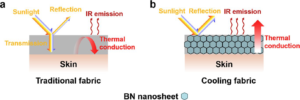 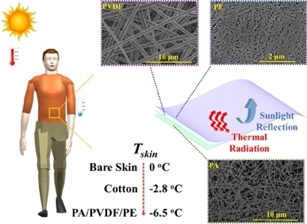 |
| Duration | 1. 3. 2026 – 28. 2. 2029 |
| Funding | 450.000 EUR |
| Sub-project head | Prof. Dr. Vanja Kokol https://cris.cobiss.net/ecris/si/sl/researcher/8756 |
| Participating organizations | BETI textile industry d.o.o. https://www.beti.si/en/ IOS d.o.o. https://ios.si/en/home-2/ |
| Objectives | This project aims to develop novel platform technology for the production of thermally conductive and solar reflective PES and PA6 filament yarns by interface-integrated (low-cost, non-toxic, skin-safe) hexagonal-nanostructured boron nitride (hBN) of high thermal stability, superior in-plane thermal conductivity, large refractive index, and a wide band gap to effectively reflect or scatter sunlight and brings favorable passive radiative cooling properties. This will be achieved by (i) appropriate exfoliation and dispersing of different hBNs, and their integration in filament outer-surface structure using existing and incorporating more advanced technological processes, i.e. during (ii) draw-texturing phase, (iii) batch-exhaustion processing performed on pre-textured and/or differently-twisted filament yarns, (iv) spraying and near-infrared (NIR) radiation drying as economically and ecologically more acceptable alternative to conventional oven-curing. Plasma pre-treatment will be included to enhance the adhesion and orientation of hBNs. The fundamental thermal transport mechanisms will be evaluated by developing and validating a numerical model that will allow further optimization of the filament nanostructure design for their better performance. The influence of both yarn and fabric constructional parameters will be addressed to further increase cooling efficacy. A representative technology will be assessed by sustainability (LCA). |
| Specific phases and stage of realization |
|
| Bibliographic references | Articles Scientific conference contributions |


ARIS-J2-70109


